

On January 26, we welcomed at the Library of the Bank of Spain a group of 17 SEDIC members for a guided visit to the exhibition that was then on display in the reading room.
As shown in the brochure produced for the occasion, the exhibition consisted of 17 items from the Library’s Special Value Collection, most of them printed by Joaquín Ibarra, although it also included two works printed by his widow and his daughter. The exhibition aimed to show how the extensive body of work printed in Ibarra’s workshop (more than 2,700 titles, of which the Library of the Bank of Spain holds 374) reflects the ideas of the Enlightenment, as well as the economic, social, and cultural situation of Spain. It also sought to demonstrate how Joaquín Ibarra’s legacy can still be seen in contemporary typography, with a display case dedicated to activities carried out in Spain during the 20th and 21st centuries.
José Luis Galán, Head of the Library, welcomed the group, after which two documentation specialists guided the tour through the display cases, following an introduction to Ibarra’s life. This introduction explained how he settled in Madrid, first with his uncle Antonio Marín and later in his own workshop. The first display case featured several books that attracted the attention of the exhibition team, either because of their subject matter, because they were the oldest Ibarra-printed works held by the Library, or due to curiosities such as the placement of the printer’s mark in an unusual location. The following display cases presented topics that were prominent during the Spanish Enlightenment, such as education, numismatics, and the expulsion of the Jesuits.
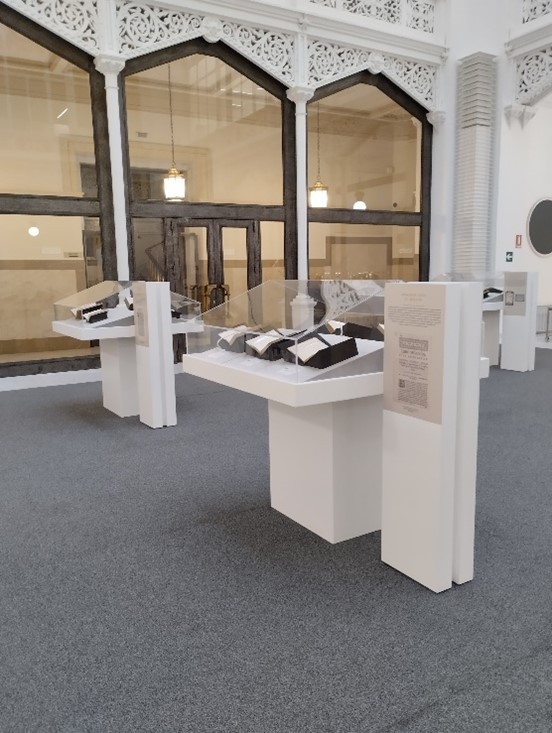
View of the exhibition
We would like to make special mention of Joaquín Ibarra’s relationship with the Banco Nacional de San Carlos, the predecessor of today’s Bank of Spain. In Ibarra’s workshop, the founding report of the institution—presented by Francisco de Cabarrús to King Charles III—was printed, as well as the first banknotes issued by the institution. Ibarra was also one of its original shareholders, and his presses produced various editions of the shareholders’ meetings, with the most recent ones printed by his successors.
The works printed by Ibarra reflect the concerns and issues that were most prominent at the time, and a good example can be found in the so-called Juicio Imparcial…. In it, the Count of Campomanes refutes the arguments that Pope Clement XIII had put forward against the doctrine of regalism, strongly defended by Charles III, which asserted the supremacy of the monarch’s authority, in certain matters, over that of the Pope. Campomanes was accused of heresy by part of the ecclesiastical hierarchy, and his dismissal was requested. However, Charles III kept him in his position, supported him, but ordered that all copies of this work that had already been distributed be withdrawn, that the text be revised to clarify the most controversial points, and that a second edition be published. All of this was only possible thanks to the rapid response that a large-scale workshop such as Ibarra’s could provide.
The exhibition also featured one of the most outstanding works printed by Ibarra: The Conspiracy of Catiline and the Jugurthine War, commonly known as the Sallust after its author, Gaius Sallustius Crispus. In this work, Ibarra introduced a truly innovative approach: he placed the Spanish translation in a prominent position, set in italics and running text, while positioning the original Latin text at the bottom of the page in two parallel columns. Typically, such translations—common at the time—were limited to presenting the original and translated text side by side in two columns. Moreover, this edition, conceived as a state project and promoted by the Royal Household, included contributions from some of the finest artists of the time, such as Mariano Salvador Maella, Manuel Salvador Carmona, and the cartographer Juan de la Cruz.
In recent years, there have been several renewed approaches to Ibarra’s work as a typographer. As early as the 1930s, the Richard Gans type foundry commissioned a typeface based on Ibarra’s edition of the Sallust, which became highly successful, even beyond Spain, and was later digitized at the end of the 20th century by Madrid’s School of Art No. 10. This typeface was also used in 2005, on the occasion of the 4th centenary of the publication of Don Quixote (1605–2005), when the Conde Duque cultural center in Madrid hosted the installation “madridquijote,” where the first part of the novel could be read on the largest book-page ever produced.
Also in the early 2000s, the National Chalcography Office promoted a project on the Royal Printing House, led by José María Ribagorda, who, inspired by the typeface used by Ibarra in his 1780 edition of Don Quixote, designed the digitized typeface known as Ibarra Real.
After the exhibition visit, we accompanied the SEDIC members on a short tour of some of the most emblematic spaces in the Bank of Spain building, such as the imperial staircase and the Echegaray rotunda (which connects the original building with the first extension from the 1930s).
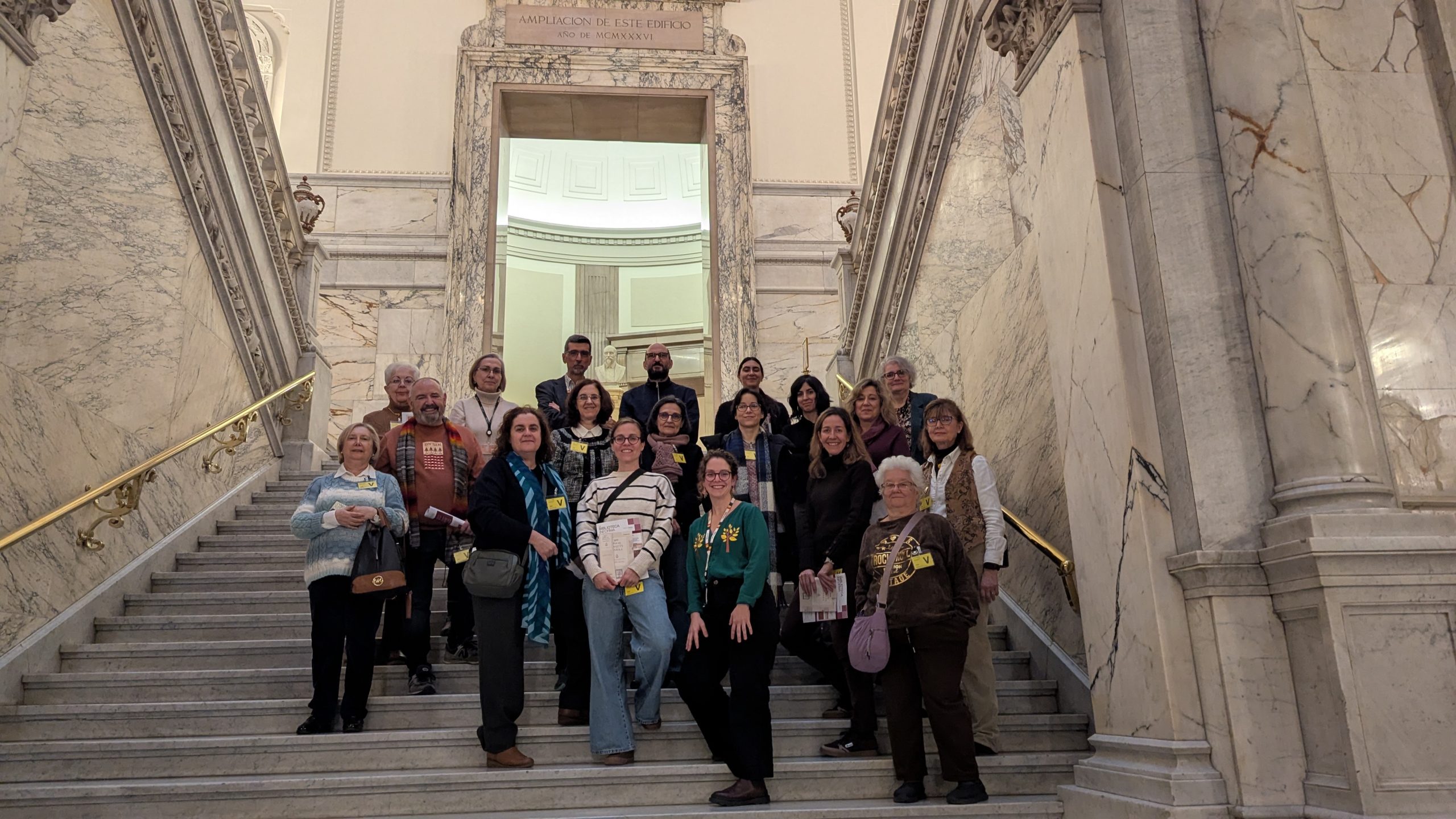
Imperial staircase
Azucena Moreno and Lourdes Pérez
Documentation specialists at the Library of the Bank of Spain*
* The opinions and analyses expressed in this blog are the responsibility of the authors and do not necessarily reflect those of the Bank of Spain or the Eurosystem.